Roofing & Waterproofing · Calabasas · October 19, 2026 · 8 min read
Roof Replacement Calabasas: 7 Signs Your Home Needs a New Roof Before Fire Season



Santa Ana wind season is here, and in the hills around Calabasas, fire season no longer has a neat start or finish. Your roof is the largest surface of your home exposed to wind-blown embers, and its condition decides a lot about how your house fares when a fire runs nearby.
This guide covers seven signs that point to a roof replacement Calabasas homeowners should plan now instead of patching again. It also explains what a Class A roof in a wildfire zone really involves, why vents matter as much as shingles, and when repair stops making sense.
We have repaired and replaced roofs across the West Valley for more than 15 years, from tract homes in Woodland Hills to estate roofs in The Oaks. The patterns below come from what we find on those roofs.
Why Fire Season Changes the Roof Math in Calabasas
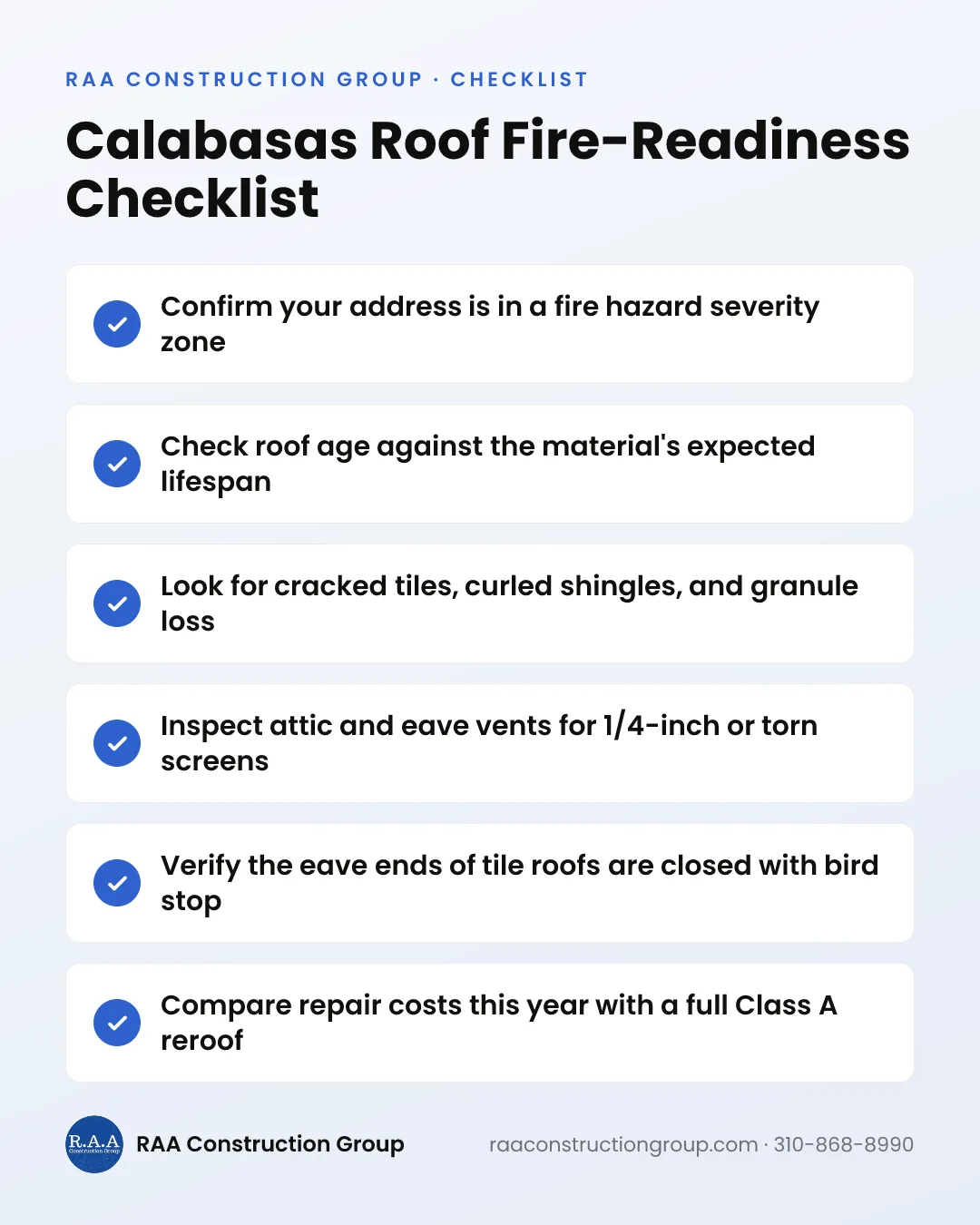
Much of Calabasas and the surrounding Santa Monica Mountains is mapped as a Very High Fire Hazard Severity Zone. You can check your address on the state fire hazard maps or ask your building department. If you are in one, a new roof is held to the ignition-resistant construction standards in Chapter 7A of the California Building Code.
Many homes lost in wildfires do not burn from a wall of flame. They ignite from embers that land in gutters, slip under tiles, or get pulled through attic vents. A roof that looks fine from the street can still have open eave ends, debris-packed valleys, and vents with oversized screens.
So the question is not only whether your roof leaks. It is whether your roof, vents, and edges work together as a system that keeps embers out.
The 7 Signs Your Roof Needs Replacement, Not Repair
Any one of these justifies a closer look. Two or three together usually mean you are spending money on a roof near the end of its life.
- 1Wood shake roofing. Untreated shakes are a serious ember risk, and treated shakes lose protection as they weather. Replacing a wood roof with a Class A assembly is the single biggest fire upgrade most homes can make.
- 2A composition roof past 20 years. Asphalt shingles in our heat typically last about 20 to 30 years. Past 20, they turn brittle, and every repair tends to crack the shingles around it.
- 3Granule loss, curling, or bare spots. Granules in the gutters mean shingles are losing their protective surface. Curled tabs lift in Santa Ana gusts and let embers and rain underneath.
- 4Tile roofs with failing underlayment. Tiles can last 50 years or more, but the underlayment beneath usually lasts 20 to 30. On Calabasas homes from the 1970s and 80s, we often find original felt that has turned to powder under good-looking tile.
- 5Cracked, slipped, or open-ended tiles. Broken tiles and eave ends without bird stop give embers and debris a direct path to the deck.
- 6Stains, soft spots, or recurring leaks. Ceiling stains, daylight in the attic, or spongy decking point to rotted sheathing. Once the deck is compromised, surface repairs only buy months.
- 7Your roofer or insurer keeps flagging the same roof. If you have paid for several repairs recently, or your carrier is asking about roof age and condition, the roof has become a liability.
Do not walk a tile roof yourself. Tiles crack underfoot and can create the very leak you were looking for. Use binoculars from the ground and a flashlight in the attic, then have a professional inspect it.
What a Class A Roof in a Wildfire Zone Actually Means
Class A is the highest fire-resistance rating for roof coverings under standardized testing for flame spread and burning embers. California requires Class A roofing on new roofs in Very High Fire Hazard Severity Zones, and reroofs are generally held to the same standard. Your building department will confirm what applies to your project.
The word many homeowners miss is assembly. Some materials are Class A on their own, while others earn the rating only over a specific underlayment or cap sheet. A Class A roof in a wildfire zone is the whole system, not just the top layer.
- Clay and concrete tile: Class A in most cases, heavy, long-lasting, and common on Mediterranean-style Calabasas homes. Eave ends must be fire-stopped.
- Architectural asphalt shingles: most carry a Class A rating, cost less, and weigh far less than tile.
- Standing seam or stone-coated metal: strong ember performance, usually rated Class A as an assembly.
- Low-slope TPO or cap sheet: common on additions and modern homes, rated by assembly, so installation details matter.
We also detail metal valley flashing over a mineral-surfaced cap sheet, metal drip edge, sealed ridges, and noncombustible gutter guards. Valleys and gutters collect debris, and debris is fuel.
Ember Resistant Vents in California: The Overlooked Upgrade
Attic and eave vents are one of the most common ways embers get inside. Older homes typically have 1/4-inch screen, large enough for embers to pass. Current ignition-resistant standards call for much finer mesh, generally no larger than 1/8 inch, or vents tested and listed for ember and flame resistance.
Ember resistant vents California homeowners can choose include baffled vents that block wind-driven embers, intumescent vents that seal when heated, and fine-mesh vents. Each affects airflow differently, so attic ventilation should be recalculated, not just swapped one for one.
A reroof is the right time for this work because vents, eave blocking, and ridge are all exposed. If you are also replacing old windows, dual-pane tempered glass is the companion upgrade. See our windows and doors services.
Ask every roofer you interview which vents they will install, how they will close tile eave ends, and whether ventilation is being recalculated. Vague answers usually mean the bid only covers the roof covering.
When Repair Still Makes Sense, and When It Stops
Repair is reasonable when the roof is in the first half of its life, the problem is localized, and the deck is sound. A few cracked tiles, one failed flashing, or a leak at a single vent pipe are repair jobs.
Repair stops making sense when:
- You have paid for two or more leak repairs in roughly three years
- Underlayment is brittle across multiple slopes
- The roof is wood shake or not rated Class A
- Repair quotes approach a third of replacement cost, a rule of thumb we use
- Vent and eave upgrades require opening the roof anyway
For tile roofs, a middle path is a lift and relay. We remove the tile, replace underlayment and flashings, and reinstall sound tiles with matching replacements. It costs less than new tile and keeps the look your HOA approved.
Permits, HOAs, and Jurisdiction in Calabasas
Most Calabasas addresses fall under the City of Calabasas, but some pockets are unincorporated LA County, and the gated City of Hidden Hills has its own rules. Confirm which building department owns your street before you start, because permit and inspection steps differ.
Reroofs generally require a permit, and in a fire zone the inspector checks the covering rating, underlayment, flashing, and vents. The Oaks, Mountain View Estates, and Calabasas Park Estates also have HOA review for roof color and material, which can take longer than the permit.
We handle permits and inspections as part of our roofing and waterproofing services and coordinate gated-community access for crews and deliveries. Learn more about our local work on our Calabasas page.
Roof Replacement Calabasas Costs and Timeline
Price depends on roof size, pitch, access, material, and how much decking needs replacing. These are typical Los Angeles-area ranges per roofing square (100 square feet), not quotes.
- Architectural composition shingle: about $600 to $1,100 per square
- Tile lift and relay with new underlayment: about $800 to $1,400 per square
- New concrete tile: about $1,100 to $1,900 per square
- New clay tile: about $1,500 to $2,800 per square
- Standing seam metal: about $1,400 to $2,500 per square
Vent upgrades, sheathing, and gutters are usually separate line items. Estate homes with steep hips, many valleys, and hillside access land at the higher end.
Most composition reroofs take 3 to 7 working days once materials arrive, and tile projects often take 2 to 4 weeks, plus permit and HOA time. Our proposals are fixed-price, and our work carries a one-year workmanship warranty.
How to Plan Your Reroof Before the Next Red Flag Day
- 1Confirm your fire hazard zone and which building department covers your address.
- 2Get an inspection that includes the attic, vents, eaves, and underlayment.
- 3Choose a material based on fire rating, weight, HOA rules, and budget.
- 4Submit HOA paperwork early, then file for the permit.
- 5Clear gutters, valleys, and overhanging branches while you wait.
- 6Schedule installation in a dry window with tarps on standby during tear-off.
A roof inspection Calabasas homeowners book now leaves time to compare options instead of reacting after a leak or a red flag warning. Neighbors in Agoura Hills face similar fire-zone rules, and our decks and patios team can spec ignition-resistant materials for decks near the house. When you are ready, schedule a free on-site estimate.
Get Your Calabasas Roof Fire-Ready
Book a free on-site roof inspection and a fixed-price proposal that covers Class A roofing, ember-resistant vents, and permits. Call 310-868-8990.
Schedule a Free EstimateFAQ