Garage Conversions & ADUs · November 19, 2026 · 9 min read
JADU vs ADU in California: Rules, Costs, and Which Fits Your Home


If you have a spare bedroom or an attached garage and want rental income or a place for family, the first decision is usually JADU vs ADU. Both are legal second units under California law, but they follow different rules on size, owner occupancy, kitchens, and bathrooms. Their costs can differ by a few hundred thousand dollars.
In our projects across the San Fernando Valley and Ventura County, we see homeowners pick the wrong unit type because they compared price alone. This guide walks through the rules, typical costs, and realistic rent so you can choose the unit that fits your lot, your budget, and how you plan to live.
One note before we start: California ADU law is amended often. We describe the rules as they generally apply today, but confirm the details with your city or a licensed contractor before you design.
JADU vs ADU: The Core Difference
A junior accessory dwelling unit (JADU) is a small unit carved out of space inside your existing single-family home. An accessory dwelling unit (ADU) is a complete, independent home that can be detached, attached as an addition, or converted from existing space such as a garage.
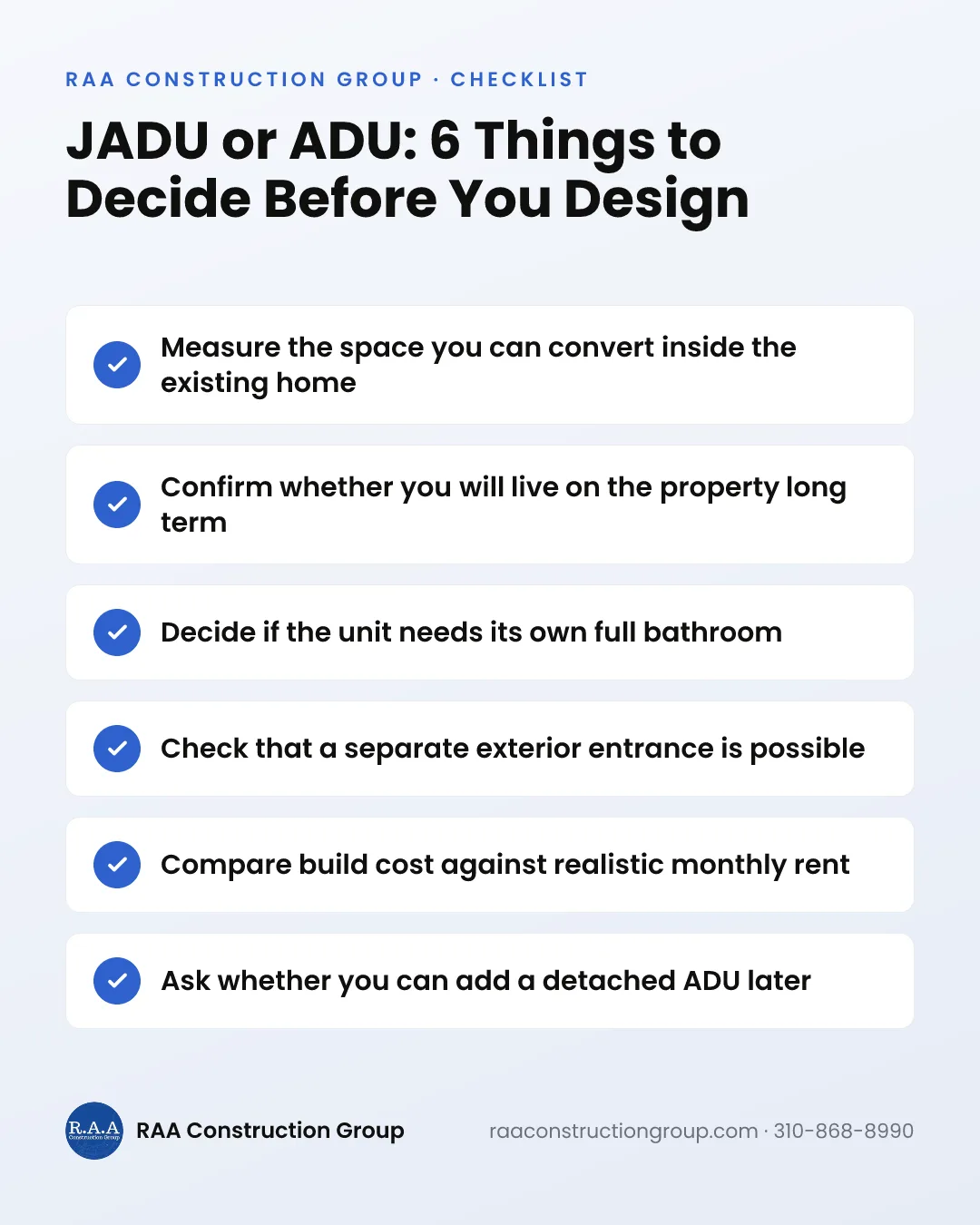
The practical difference is independence. An ADU must have its own full kitchen and bathroom. A JADU only needs an efficiency kitchen and can share a bathroom with the main house, which keeps cost down but limits who will want to live there.
- Size: a JADU is capped at 500 square feet; a detached ADU can typically reach 1,200 square feet, subject to local rules
- Location: a JADU sits inside the existing home; an ADU can be detached, attached, or converted
- Kitchen: a JADU needs an efficiency kitchen; an ADU needs a full kitchen
- Bathroom: a JADU may share with the main house; an ADU must have its own
- Owner occupancy: historically required for JADUs; generally not allowed as a condition for standard ADUs
- Sale: in most cities, neither unit can be sold separately from the main house
Size Limits and Where Each Unit Can Go
A JADU can be no larger than 500 square feet and must be contained within the walls of the single-family home. Under state law, an attached garage counts as part of the home, so converting part or all of an attached two-car garage is a common JADU path.
ADUs have more room to grow. State law sets minimum allowances that cities must permit, including a detached ADU of at least 800 square feet, up to 16 feet tall, with 4-foot side and rear setbacks for most detached units. Many cities allow detached ADUs up to 1,200 square feet. Our guide to ADU setback rules in Los Angeles covers what fits on different lot shapes.
On a typical Valley lot with a 1950s or 60s ranch house, a JADU usually comes from a back bedroom and adjacent bath near a side-yard door. A detached ADU needs open yard space, a route for utility trenching, and clear access for inspectors and fire crews.
Site conditions matter more for ADUs. A new detached unit in a Very High Fire Hazard Severity Zone needs Chapter 7A ignition-resistant construction, and hillside lots can add grading and access review. A JADU reuses the existing structure, so it often sidesteps many of those issues.
Junior ADU Requirements California: Kitchen, Bath, and Entrance
The junior ADU requirements California sets statewide are short, but each one affects layout and budget. Here is what a JADU generally needs:
- A separate exterior entrance, independent of the main front door
- An efficiency kitchen with a cooking appliance, a food prep counter, and storage cabinets of reasonable size
- A bathroom, which may be shared with the main house if the JADU has interior access to it
- No more than 500 square feet of floor area
- A building permit, plan check, and inspections through LADBS in the City of Los Angeles or the city's building department elsewhere
- Title 24 energy compliance for converted or newly conditioned space
An efficiency kitchen does not mean a full range and dishwasher. In practice we usually install a compact cooktop or range, a sink, a small refrigerator, and a run of base and upper cabinets. The sink is worth including even when it is not strictly required, because nobody wants to wash dishes in a bathroom.
For utilities, a JADU is generally treated as part of the main house. That means you usually do not need a new sewer lateral or a separate meter, which is a big reason JADUs cost less. Older Valley homes with 100-amp panels may still need a service upgrade once you add cooking and heating loads.
If you might ever rent to someone outside the family, give the JADU its own bathroom. A shared bath works for an aging parent or adult child, but it shrinks your rental pool and creates daily privacy friction.
JADU Owner Occupancy and Deed Restrictions
JADU owner occupancy has been one of the defining rules. Under state law, the owner has been required to live in either the main house or the JADU, with narrow exceptions for certain public agencies and housing organizations. The legislature has revisited JADU rules in recent sessions, so confirm the current version with your city before you commit.
Cities also require a deed restriction recorded against the property before final sign-off. It typically prohibits selling the JADU separately from the home, restates the size and features limits, and puts future buyers on notice.
Standard ADUs work differently. Under current state law, cities generally cannot require owner occupancy for an ADU, so you could move out and rent both the main house and the ADU. If you expect to relocate within a few years, that flexibility can outweigh the JADU's lower cost.
Deed restrictions, trusts, and future sale plans have legal and tax implications. Ask a real estate attorney or tax professional how they apply to your situation.
Can You Build Both a JADU and an ADU?
In most cases, yes. State law allows a single-family lot to have a JADU and a detached new-construction ADU at the same time. A popular Valley combination is a JADU in part of the attached garage for a parent, plus a detached backyard ADU for rental income.
Some combinations, such as a converted-garage ADU plus a JADU plus a detached ADU, depend on how your city applies state law and on your lot. That question belongs in the feasibility review, before you pay for full drawings.
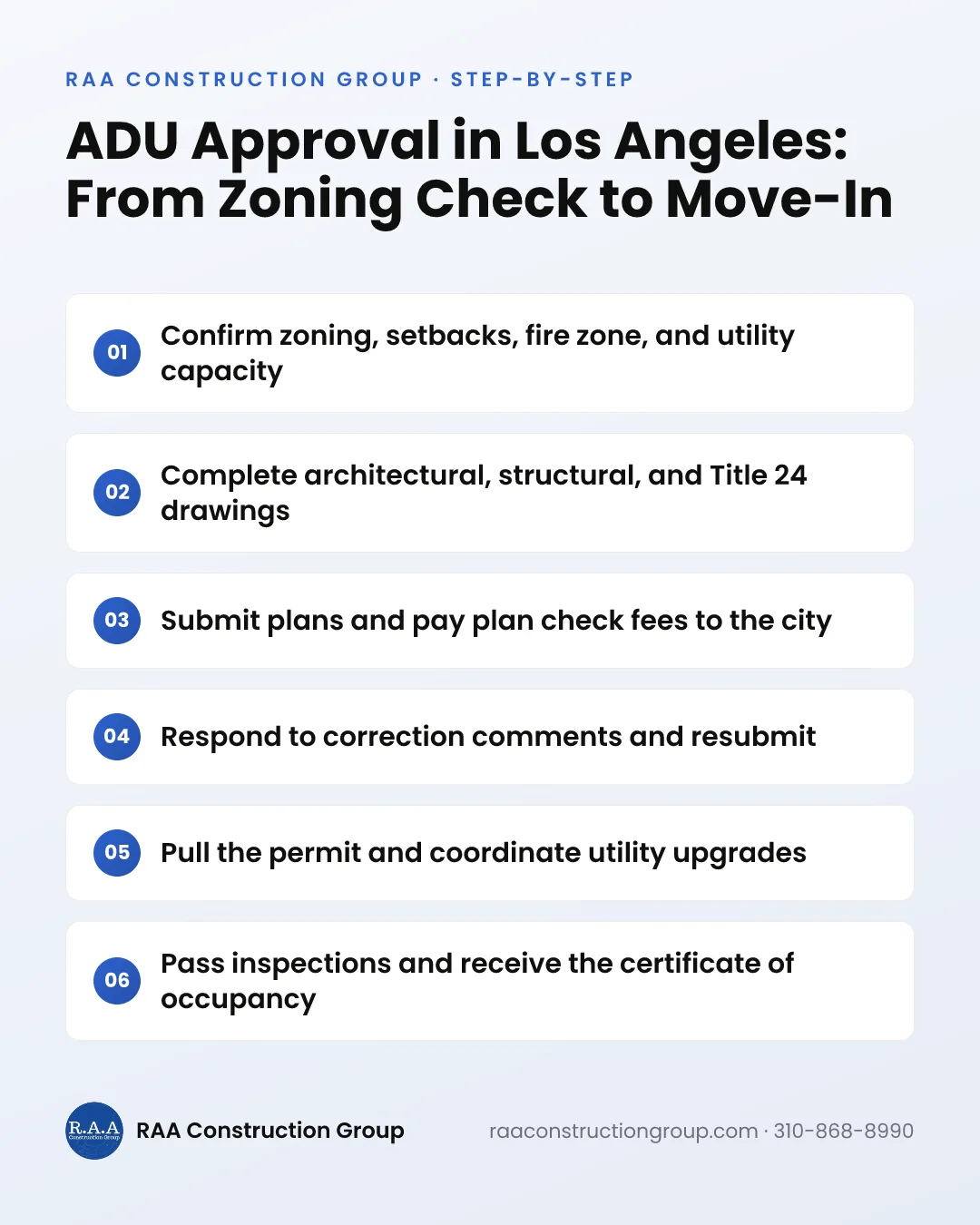
- 1Review the lot, setbacks, utility locations, and electrical panel capacity
- 2Design both units together, even if you build them in phases
- 3Size the electrical service and sewer route for the final build-out
- 4Submit coordinated plans for permit review
- 5Build the phase that fits your budget first, then add the second unit
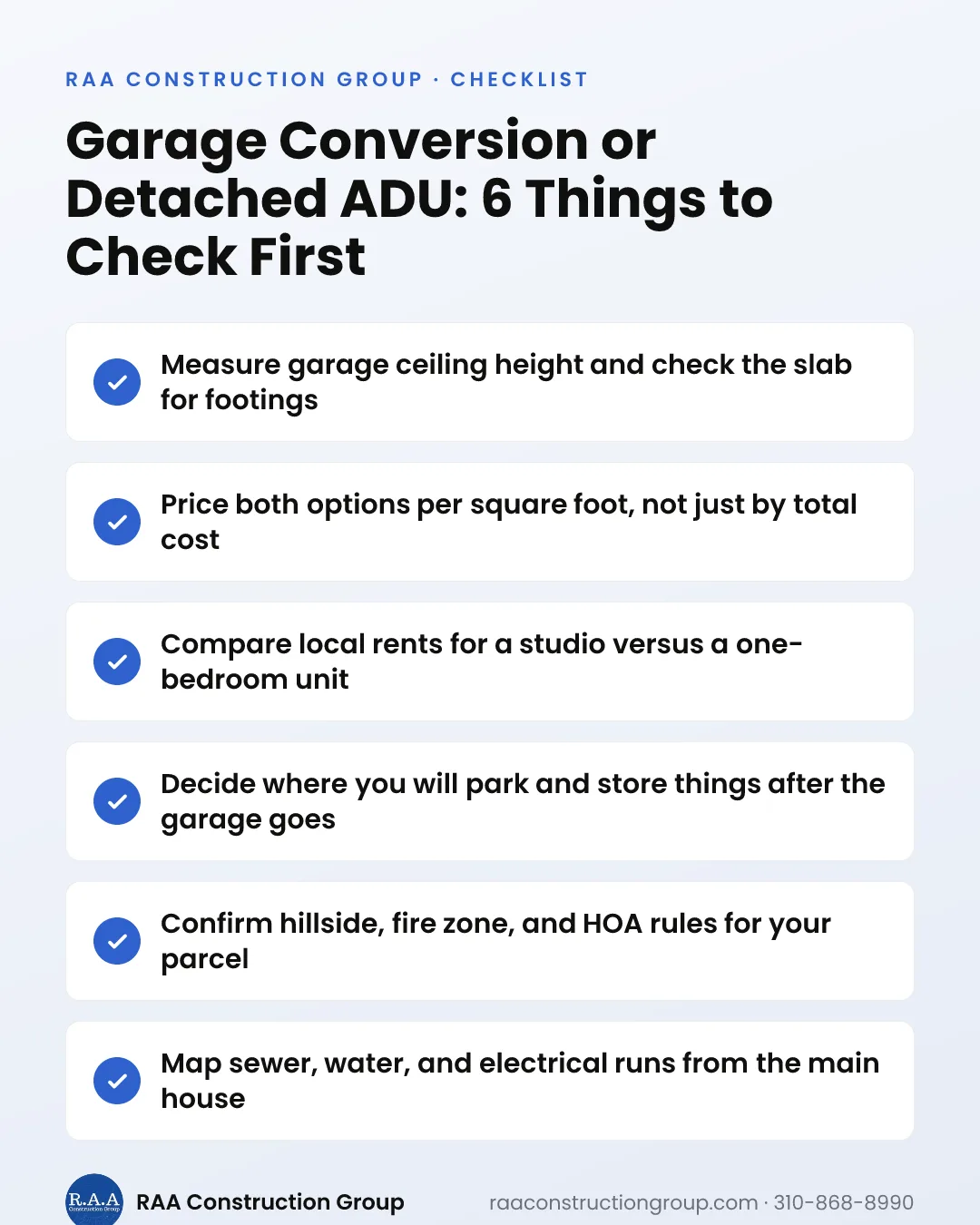
Planning both at once prevents expensive rework, like trenching through a finished patio for a sewer line. If you are weighing garage options, our comparison of a garage conversion vs detached ADU in Encino walks through the trade-offs.
JADU Cost vs ADU Cost in Los Angeles
JADU cost is driven by how much of the existing space you can reuse. The ranges below are typical Los Angeles-area figures that vary widely by scope, site, and finishes. They are planning numbers, not quotes.
- JADU from a bedroom with an existing bathroom: about $45,000 to $100,000
- JADU in an attached garage, adding a bathroom: about $90,000 to $160,000
- Garage conversion ADU from a detached garage: about $130,000 to $230,000
- New detached ADU of 600 to 1,200 square feet: about $250,000 to $450,000 or more
For a JADU, the biggest cost swings come from cutting in a new exterior door, running plumbing for a kitchen sink or new bathroom, insulating garage walls and ceilings for Title 24, and adding windows that meet egress rules.
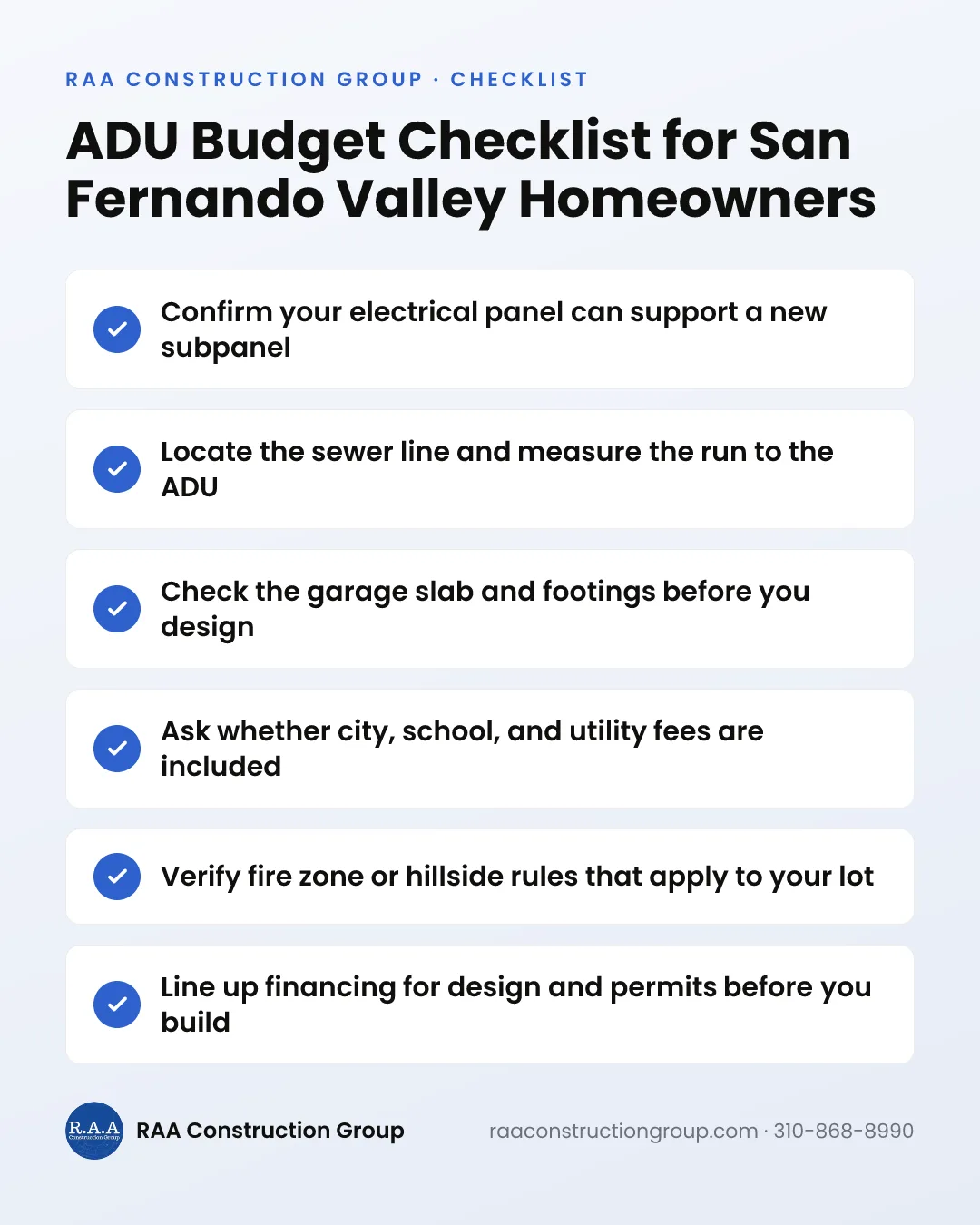
For a full ADU, foundation work, a separate electrical subpanel, a sewer lateral, utility trenching, and full kitchen and bath finishes push the budget up. Our breakdown of ADU cost in the San Fernando Valley goes deeper by unit type.
Before you price a garage JADU, measure the step from the garage slab down to the house floor. Many Valley garages sit several inches low and slope toward the door, and leveling the floor can add real cost.
Rent, Payback, and Which Fits Your Home
Rent follows independence. As rough San Fernando Valley ranges that vary by neighborhood and finish, a JADU studio often rents for about $1,500 to $2,300 a month, a one-bedroom detached ADU for about $2,400 to $3,200, and a two-bedroom for about $3,000 to $4,000. Check local listings for current comparables.
Here is a simple gross example. A $75,000 JADU renting at $1,800 a month brings in $21,600 a year, roughly 3.5 years of gross rent to cover the build. A $350,000 detached ADU at $3,000 a month brings in $36,000 a year, closer to 10 years. Taxes, insurance, financing, and maintenance change both numbers, and many cities require rentals of 30 days or more.
- A JADU fits if you will live on the property, have an underused bedroom or attached garage, and want a lower budget
- A JADU fits if the occupant is family and a shared bath is acceptable
- An ADU fits if you want full independence, maximum rent, or the option to move out and rent both units
- An ADU fits if you have yard space and plan to hold the property long term
As a licensed California contractor (CSLB #1047380) with more than 15 years of ADU and conversion work, we handle JADUs and ADUs from feasibility through certificate of occupancy. See our garage conversions and ADUs service, or schedule a free on-site estimate to find out what your home can support.
Not sure whether a JADU or ADU fits your home?
Book a free on-site consultation and get a fixed-price proposal from a licensed design-build team. Call 310-868-8990 or schedule online.
Schedule a Free EstimateFAQ