Roofing & Waterproofing · October 27, 2026 · 8 min read
Flat Roof Waterproofing Cost Los Angeles: TPO vs. Torch-Down vs. Coatings
If your mid-century home has a flat or low-slope roof, you have probably found a ceiling stain after the first big storm of the season. The flat roof waterproofing cost Los Angeles homeowners pay depends less on the membrane brand and more on three things: the condition of the deck underneath, how well the roof drains, and whether the job triggers Title 24 cool roof rules.
Below we compare the three systems we install most often: TPO single-ply, torch-down modified bitumen, and liquid-applied coatings. You will get typical price ranges, honest trade-offs, and simple lifespan math, based on what we see on 1950s and 60s ranch and post-and-beam homes across the [San Fernando Valley](/locations/san-fernando-valley) and Ventura County.
Why Mid-Century Flat Roofs in the Valley Leak
Many postwar homes in Encino, Woodland Hills, Sherman Oaks, and Tarzana were built with tar and gravel roofs at very low slope. Original designs often had a quarter inch of fall per foot or less, drained by a few small scuppers through the parapet.
Decades later, we typically find several layers of old roofing, sagging joists that create low spots, and flashings that were caulked over instead of rebuilt. Valley summers routinely push past 100 degrees, and that heat breaks down asphalt surfaces faster than on coastal roofs.
- Parapet wall flashings and cap metal pulling loose
- Scuppers and drains that are clogged or undersized
- Penetrations around vents, AC curbs, and skylights
- Blisters and cracks in old built-up layers
- Soft or rotted sheathing at chronic low spots
Choosing a material before diagnosing these problems is how homeowners end up paying twice. If you are not sure your roof is at the end of its life, review the warning signs a roof needs replacing first.
Flat Roof Waterproofing Cost Los Angeles: Typical Ranges
These are typical Los Angeles-area ranges for a complete system on a single-family home. They vary by scope, access, deck repairs, and insulation, and they are not a quote.
- TPO single-ply with tear-off and new cover board: roughly $9 to $15 per square foot
- Torch-down modified bitumen with tear-off, base sheet, and cap sheet: roughly $7 to $12 per square foot
- Acrylic or silicone coating over a sound existing roof: roughly $3 to $7 per square foot
- Tapered insulation to correct ponding: often $2 to $5 per square foot in the affected areas
- Deck repair: usually priced per sheet of plywood, from a few hundred to several thousand dollars total
On a typical 1,500 square foot Valley ranch roof, that works out to roughly $13,500 to $22,500 for TPO, $10,500 to $18,000 for torch-down, and $4,500 to $10,500 for a coating. Removing multiple old layers, rebuilding parapets, and fixing drainage often move the total more than the choice of membrane.
TPO: Reflective, Heat-Welded, and Code-Friendly
TPO is a white thermoplastic membrane. Its seams are welded with hot air, so overlapping sheets fuse into one continuous surface rather than relying on adhesive alone.
The TPO roof cost Los Angeles homeowners see usually runs higher than torch-down because we typically add a cover board or insulation layer and wrap parapets with membrane-clad metal. In exchange, you get a bright, reflective surface that most white products already have rated for cool roof compliance, and rooms under the roof often feel noticeably cooler.
- Pros: highly reflective, welded seams, no open flame during installation, often 15 to 25 years of service with good detailing
- Cons: thinner sheets puncture more easily under foot traffic, requires a crew experienced with heat welding, patching aged TPO can be harder
On roofs with AC units or regular foot traffic, ask for a thicker membrane such as 60 mil and walk pads to the equipment. The added thickness resists punctures and gives more weathering margin.
Torch-Down Roof Replacement: Tough but Hot to Install
Torch-down modified bitumen is a rolled asphalt sheet with polymer modifiers, melted into place with a propane torch. A two-ply system with a granulated cap sheet is thick, durable, and forgiving of foot traffic and minor impacts.
The main trade-off is the open flame. Torching near wood fascia, attic vents, or dry old framing demands experienced crews and a fire watch, so we often switch to self-adhered sheets at edges and around combustibles.
Standard gray or dark granules absorb heat. If your torch down roof replacement triggers cool roof rules, you will usually need a rated reflective cap sheet or a reflective coating on top, which adds cost.
- Pros: puncture resistant, handles rooftop equipment and traffic, competitive pricing
- Cons: open flame, seam quality depends on heat and lap technique, may need an added coating for reflectivity, typically 15 to 20 years of service
Roof Coatings: When a Restoration Makes Sense
Liquid-applied acrylic, silicone, or polyurethane coatings are rolled or sprayed over an existing roof to create a seamless reflective layer. They cost the least upfront and cause the least disruption, since there is usually no tear-off.
A coating is only as good as what it covers. If the old roof is wet, blistered, or delaminating, the coating traps moisture and fails early, so we probe or core suspect areas and only recommend coatings on roofs that are dry and well attached.
- Acrylic: affordable and very reflective, but generally a poor choice where water ponds
- Silicone: handles ponding and UV better, but is slippery and limits what will bond to it later
- Thickness matters: a single thin coat may last about 5 years, while a multi-coat system with fabric at seams can reach 10 to 15 years with recoats
Title 24 and the Cool Roof Requirement California Applies
California's Title 24 energy code includes cool roof provisions for reroofing. In most inland Southern California climate zones, including much of the Valley, replacing a substantial portion of a low-slope roof generally requires a product rated by the Cool Roof Rating Council for reflectance and emittance.
The cool roof requirement California uses has exceptions and alternatives that depend on your climate zone and scope. In the City of Los Angeles, LADBS handles reroof permits and inspections; in Thousand Oaks, Simi Valley, Santa Clarita, or Calabasas, the city's building department does. We explain similar energy rules for openings in our Title 24 window replacement guide.
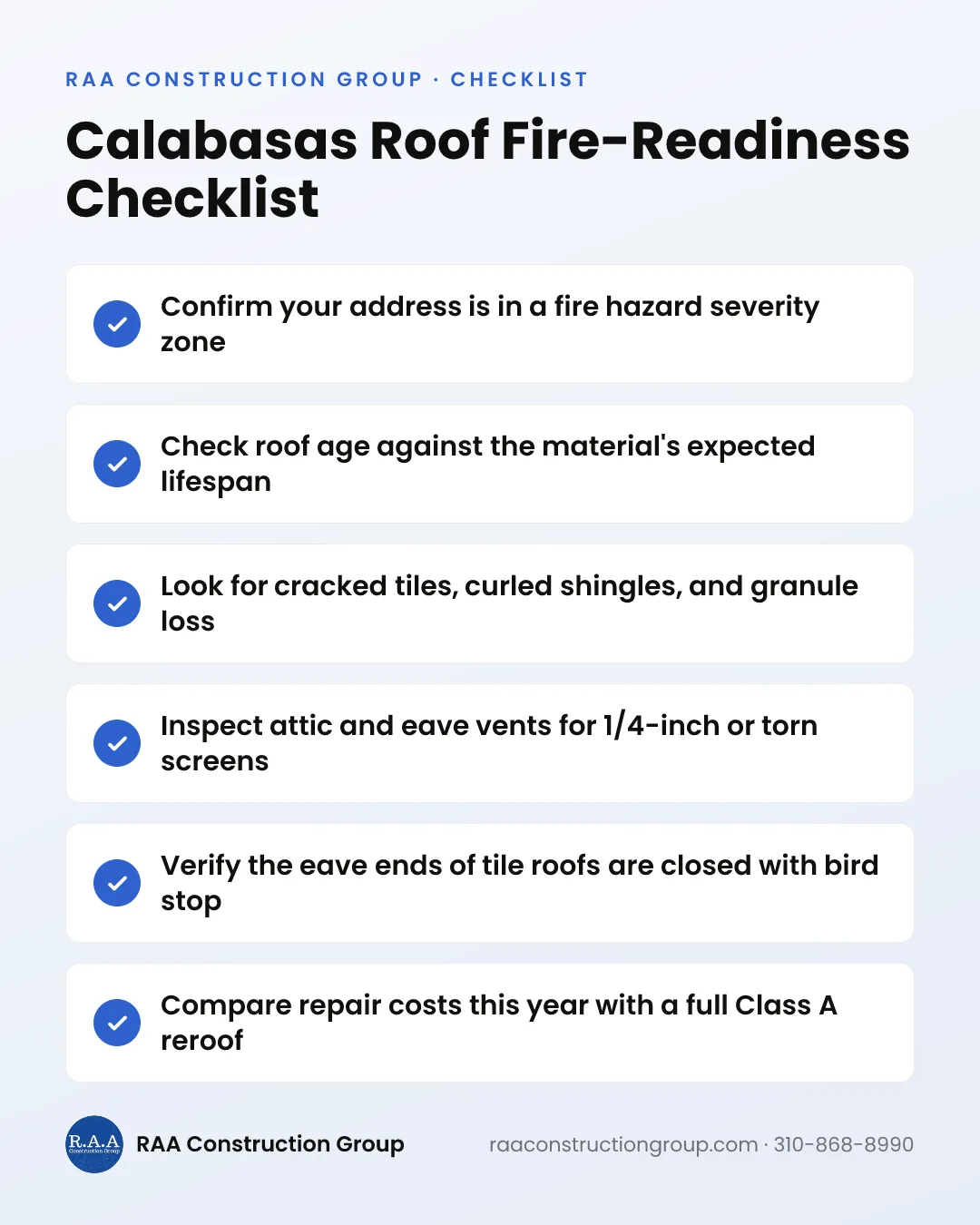
Hillside homes in Very High Fire Hazard Severity Zones, common in Calabasas, Agoura Hills, and La Cañada Flintridge, also need a Class A roof assembly under Chapter 7A. TPO and modified bitumen can meet this as tested assemblies, while a coating's rating depends on the roof underneath, so confirm the listing before you sign.
Drainage and Ponding: The Detail That Decides Lifespan
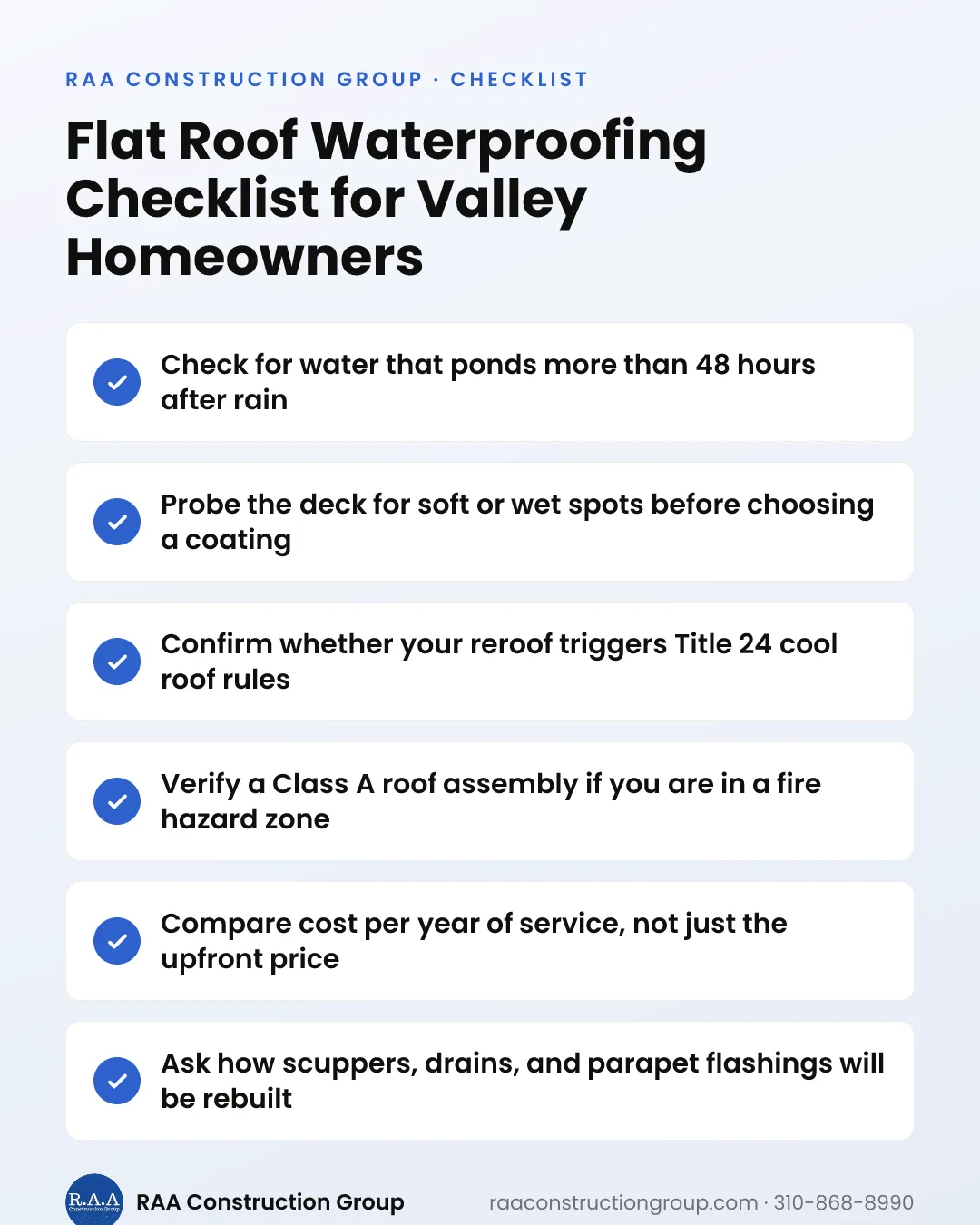
Most manufacturers treat water standing more than 48 hours after rain as ponding, and many warranties exclude damage from it. Ponding speeds membrane aging, adds weight to old framing, and finds every weak seam.
- 1Map low spots after a rain or with a controlled hose test
- 2Check framing for sag and repair it before adding any weight
- 3Add tapered insulation or crickets to push water toward drains
- 4Enlarge or add scuppers, plus overflow scuppers through parapets
- 5Connect scuppers to properly sized gutters and downspouts that discharge away from the foundation
Drainage work adds cost upfront, but in our projects it is the step that most often separates a roof that lasts 20 years from one that leaks in year five. The same principles apply to balconies and roof decks, which we cover under deck and patio work.
Lifespan Math and Getting an Accurate Quote
Upfront price is misleading on flat roofs. Divide the installed cost by realistic years of service, using midpoints for a 1,500 square foot roof.
- TPO at about $18,000 over 20 years: roughly $900 per year
- Torch-down at about $14,000 over 17 years: roughly $825 per year
- Coating at about $7,500 over 10 years with one recoat: roughly $750 per year, only if the existing roof is sound
The numbers land close together, which is why condition and drainage should drive the decision. A coating wins on a dry roof that drains well, TPO wins when you need reflectivity and cool roof compliance, and torch-down wins on roofs with heavy equipment or foot traffic.
Ask every bidder how they price deck repairs. A per-sheet price written into the proposal keeps hidden rot from becoming an open-ended change order.
In more than 15 years and 2,000+ projects, we have learned that a good flat roof bid starts on the roof, not on the phone. Our roofing and waterproofing service covers tear-off, cover board, flashings, scuppers, gutters, and permits where required.
Every fixed-price proposal lists the system, thickness, drainage fixes, and deck repair pricing, backed by our one-year workmanship warranty on top of the manufacturer's coverage. Schedule a free on-site consultation and we will tell you honestly whether you need a coating, TPO, or torch-down.
Get a Straight Answer on Your Flat Roof
Book a free on-site consultation. We inspect the deck and drainage, then give you a fixed-price proposal for the right system. Call 310-868-8990.
Schedule a Free EstimateFAQ